
- Homepage
- Conflict
- Features
- 1st Edition (28)
- Antique, Inscribed \ (2)
- Embossed (8)
- Framed (4)
- Full Of Orig Photos (2)
- Hand Tinted (9)
- Illustrated (7)
- Limited Edition (8)
- One Of A Kind (ooak) (113)
- Photo Book (7)
- Press Photograph (4)
- Rare (2)
- Signed (4)
- Standard (4)
- Stereoscopic (11)
- Stereoview (6)
- Tintype (7)
- Union Case (44)
- Unknown (2)
- White Border (2)
- ... (7286)
- Framing
- Theme
- Americana (43)
- Americana, Fashion (20)
- Americana, Militaria (20)
- Antique (9)
- Art (7)
- Civil War (14)
- Conflicts & Wars (10)
- Fashion (19)
- History (48)
- History, Militaria (14)
- Love (6)
- Militaria (1293)
- Patriotic (7)
- People (21)
- Politics (18)
- Portrait (78)
- Portrait, Man (22)
- Stamps (31)
- Travel (6)
- Victorian (7)
- ... (5867)
- Type
- Belt Buckle (3)
- Cabinet Card (2)
- Carte De Visite (2)
- Cdv (3)
- Cdv Photograph (19)
- Daguerreotype (3)
- Full Cdv Photo Album (2)
- Illustrated Book (3)
- Negative Film Photo (4)
- Pendant (3)
- Photo Album (3)
- Photo Frame (2)
- Photograph (1530)
- Photograph Album (65)
- Picture Book (10)
- Picture Frames (8)
- Print (9)
- Real Photo (rppc) (14)
- Tintype (10)
- Tintype Photo (4)
- ... (5861)
- Unit Of Sale
Civil War Matted Autograph General Simon Bolivar Buckner with photo
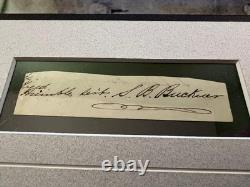
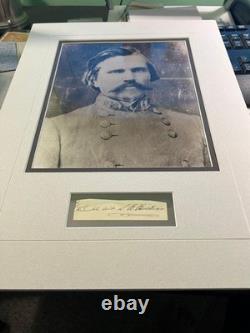

Simon Bolivar Buckner (/'sa? R; April 1, 1823 - January 8, 1914) was an American soldier, Confederate military officer, and politician. He fought in the United States Army in the Mexican-American War. He later fought in the Confederate States Army during the American Civil War. After the war, he served as the 30th governor of Kentucky. After graduating from the United States Military Academy at West Point, Buckner became an instructor there. He took a hiatus from teaching to serve in the Mexican-American War, participating in many of its major battles. He resigned from the army in 1855 to manage his father-in-law's real estate in Chicago, Illinois.
In this position, he tried to enforce Kentucky's neutrality policy in the early days of the Civil War. When the state's neutrality was breached, Buckner accepted a commission in the Confederate Army after declining a similar commission to the Union Army.
In 1862, he accepted Ulysses S. Grant's demand for an "unconditional surrender" at the Battle of Fort Donelson. He was the first Confederate general to surrender an army in the war. He spent five months as a prisoner of war. After his release, Buckner participated in Braxton Bragg's failed invasion of Kentucky and near the end of the war became chief of staff to Edmund Kirby Smith in the Trans-Mississippi Department. In the years following the war, Buckner became active in politics. He was elected governor of Kentucky in 1887, in his second campaign for that office. His term was plagued by violent feuds in the eastern part of the state, including the Hatfield-McCoy feud and the Rowan County War. As governor, Buckner became known for vetoing special interest legislation. In the 1888 legislative session alone, he issued more vetoes than the previous ten governors combined. The following year, he joined the National Democratic Party, or "Gold Democrats", who favored a gold standard policy over the Free Silver position of the mainline Democrats.He was the National Democratic Party's candidate for Vice President of the United States in the 1896 election, but polled just over one percent of the vote on a ticket with his running mate, ex-Union general John M. He never again sought public office and died on January 8, 1914.